From Automation Job to Content Control Plane: Why personal-site growth needs a governed content loop
What AIPW actually productized is not an AI writing screen, but a shared workflow that connects automation, Inbox, Topics, Drafting, Distribution, and Performance into one article-centric content control plane.
This article started as an AI-generated draft and was reviewed before publication.
TL;DR
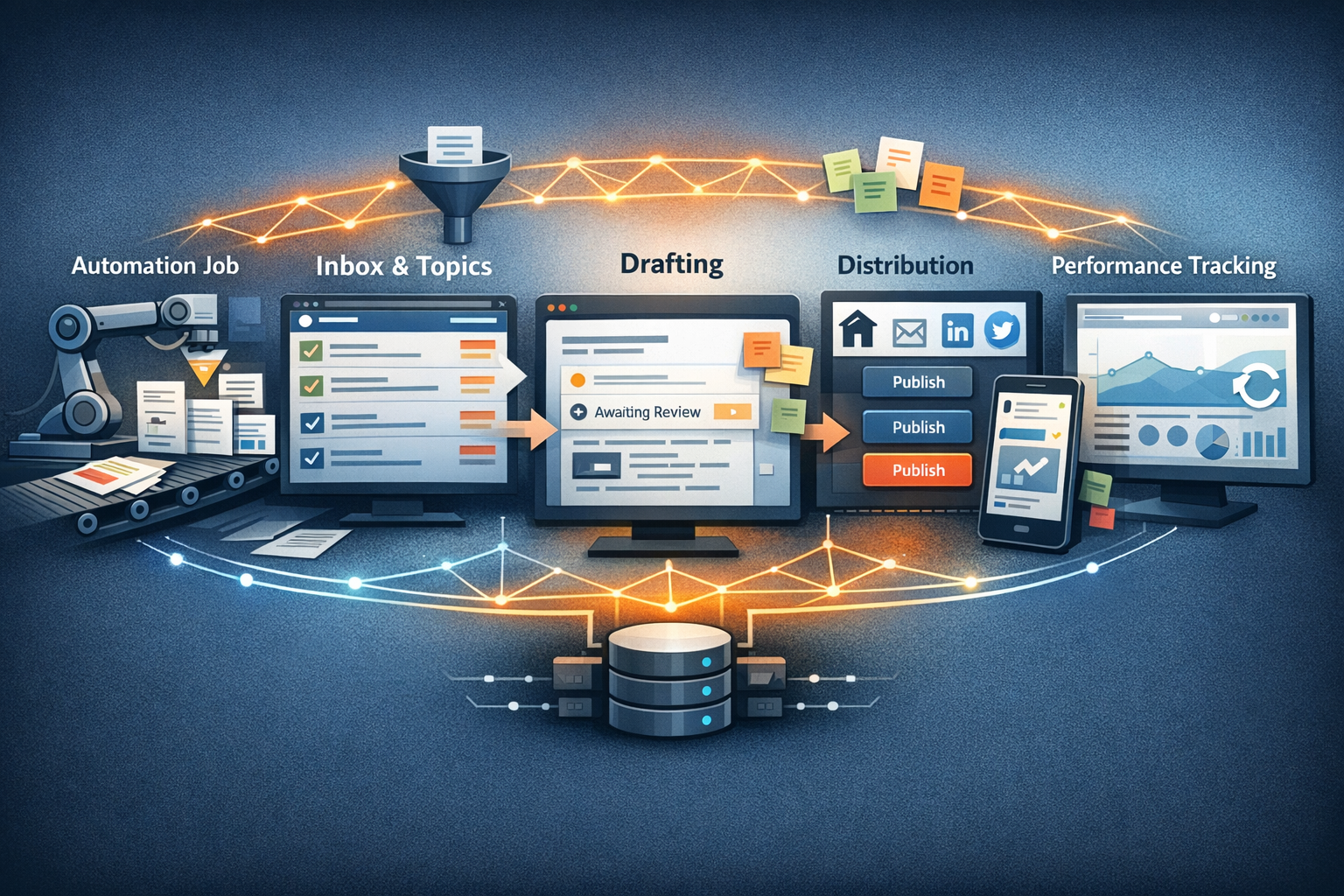
The important change in AIPW is not that it gained another AI writing page. The real shift is that automation job -> Inbox & Topics -> Drafting -> Distribution -> Performance now behaves like one content control plane. Instead of treating research, writing, publishing, and analytics as disconnected tools, each article now moves through a shared stateful workflow.
The real value is not faster generation. It is that the full content lifecycle becomes governable, observable, and improvable.
What actually changed
Most content systems are fragmented by default.
One tool finds signals. Another stores notes. Another drafts the post. Another schedules social distribution. Analytics lives somewhere else entirely. Each tool can look useful on its own, but the hardest questions usually show up in the gaps between them:
- How did this source enter the system?
- Why did this topic get promoted into a real article?
- Which evidence and context shaped this draft?
- Are the social variants still aligned with the canonical thesis?
- Did performance actually feed back into the next editorial decision?
What AIPW changed is not just the UI surface. It changed the system shape. The flow shown in the hero image is not decorative. It maps the actual loop:
Automation Jobturns research into a replayable markdown contract.Inbox & Topicshandle intake, shortlist, scoring, and review lanes.Draftingbinds bundle version, notes, resources, and review gates to the same article.Distributiontreats personal-site, LinkedIn, and X as coordinated publish surfaces of one article.Performancecloses the loop by bringing readback into the same operational view.
That is what makes this a control plane instead of just a content editor.
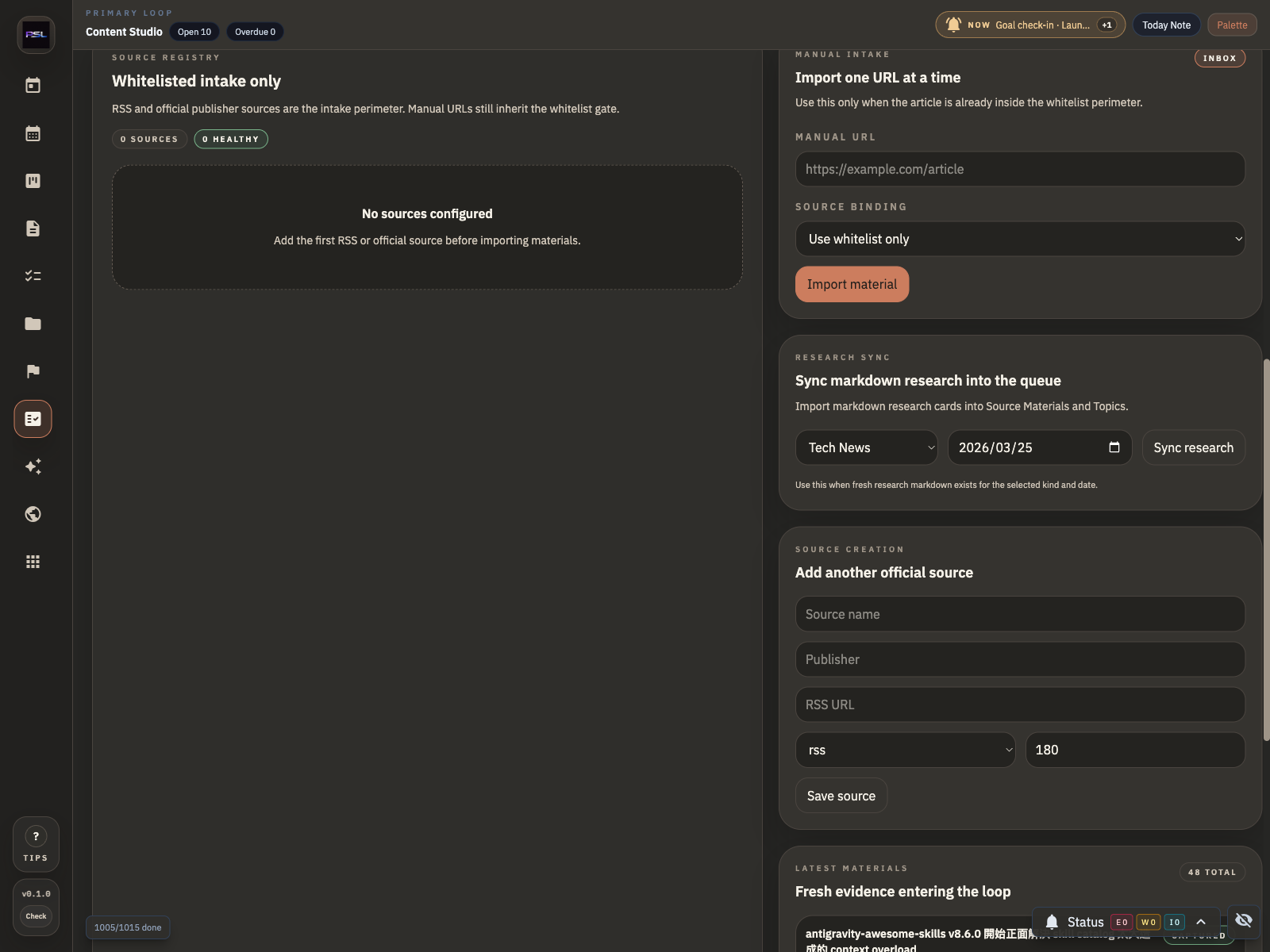
Inbox is no longer a loose capture bucket. It now acts as the intake gate for whitelisted sources, manual imports, and research sync.
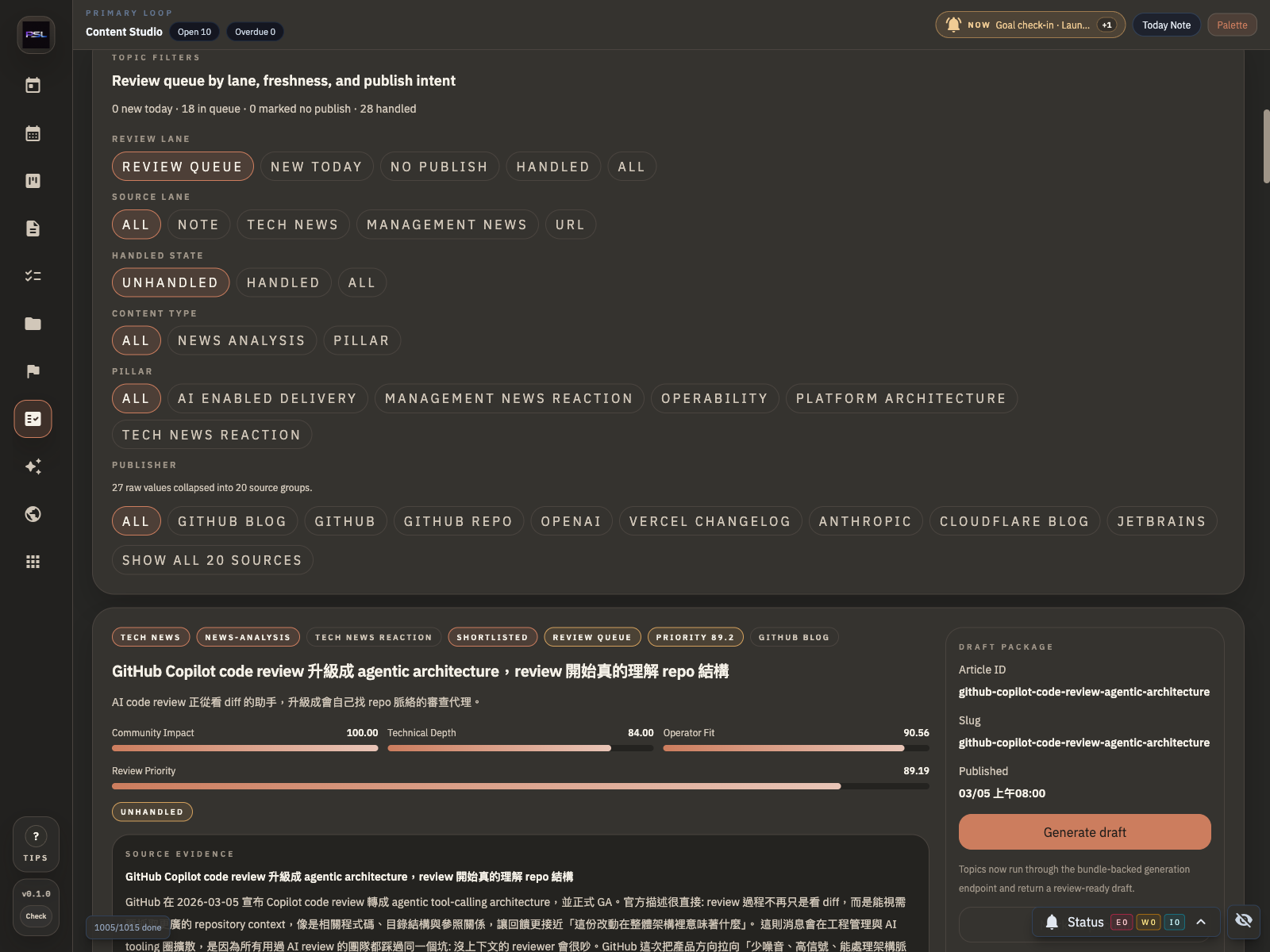
Topics puts source lane, handled state, and priority score into the same shortlist surface so the system answers “what deserves an article?” before it answers “what can be generated?”
Insight 1: The real value of automation jobs is intake discipline, not more source volume
When people hear “content automation,” they usually think about automatic discovery: more links, more news, more material. But that is not where durable systems are won.
If the output format is unstable, if the source boundary is unclear, or if reruns pollute the queue, automation simply pushes chaos downstream. In AIPW, the real job of automation is to make intake usable by the rest of the system. That means markdown-first, section-stable, replayable, and sync-safe output.
This changes the investment order. The first thing worth improving is not source count. It is source reliability. Control planes usually fail long before drafting, because intake was never structured enough to support a governed flow.
Insight 2: Drafting matters because it becomes an editorial build system
If Topics simply handed high-scoring items directly to a model, this would still be a smarter generator, not a real workflow. The important move in AIPW is that Drafting is not just text generation. Each draft carries operational context:
- bundle version
- notes and attached resources
- structured draft and refinement stages
- review gates and blockers
This is where content work starts to resemble engineering work. Once a draft keeps its context, version, evidence, and gate status, it can be reviewed, traced, revised, and governed. Without that structure, content tooling produces output but not accountability.
Many AI writing tools are limited not because they generate poorly, but because they leave nothing durable behind. No context binding, no version trail, no approval boundary, no stable operating unit.
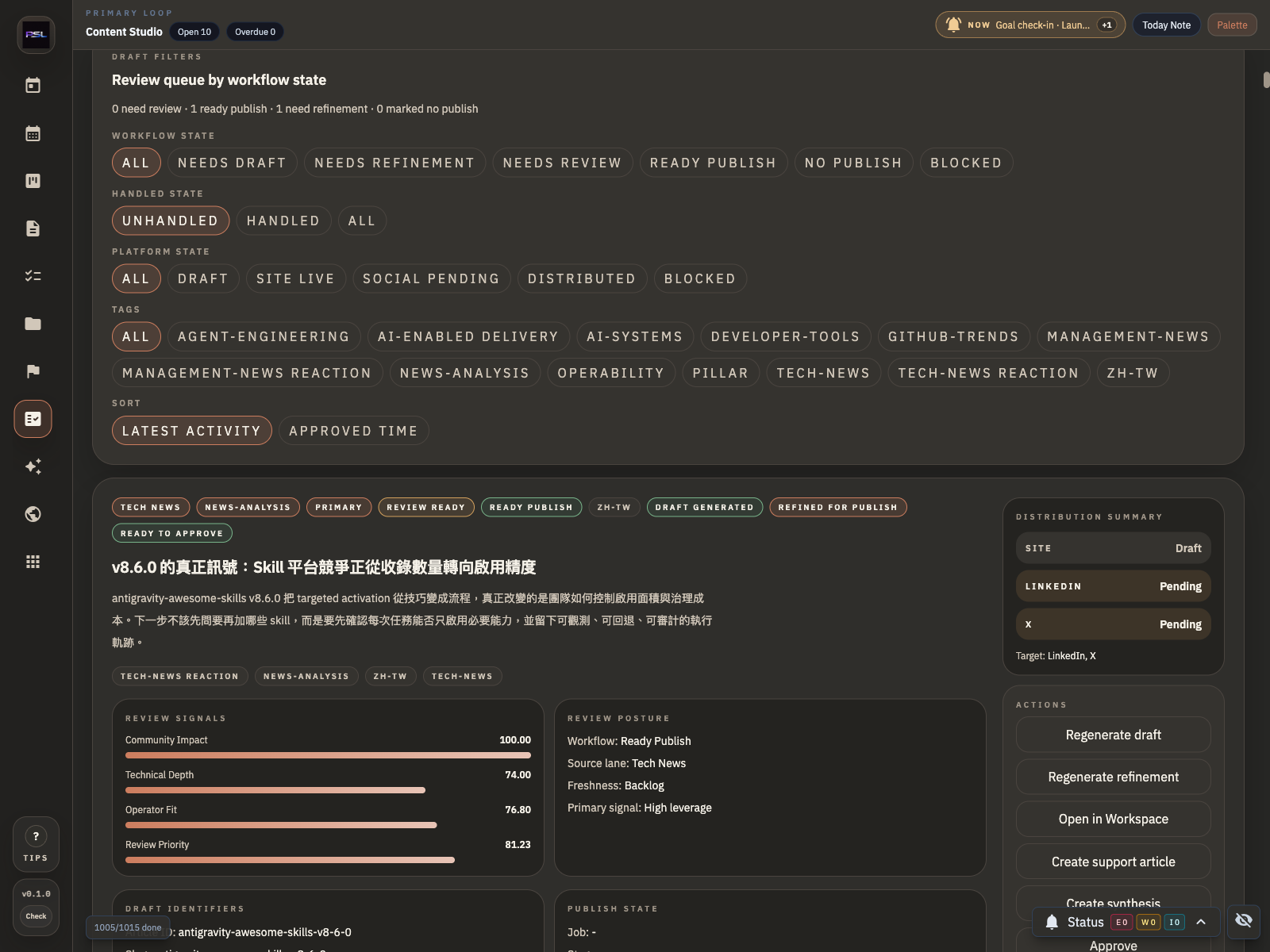
The Drafting view keeps workflow state, bundle version, review signals, and publish blockers visible on the same article record.
Insight 3: Without Distribution and Performance, the control plane is still incomplete
A lot of content systems stop at generation. They can draft, maybe even schedule, but publishing and performance still live elsewhere. That means the real article lifecycle remains fragmented.
Distribution matters because it defines the canonical surface. In AIPW, personal-site is the source of truth and social channels are downstream variants. That ordering answers several operational questions:
- Which URL is the canonical destination?
- Are LinkedIn and X aligned to the same article thesis?
- Are image selection, publish readiness, and platform targeting handled in one decision point?
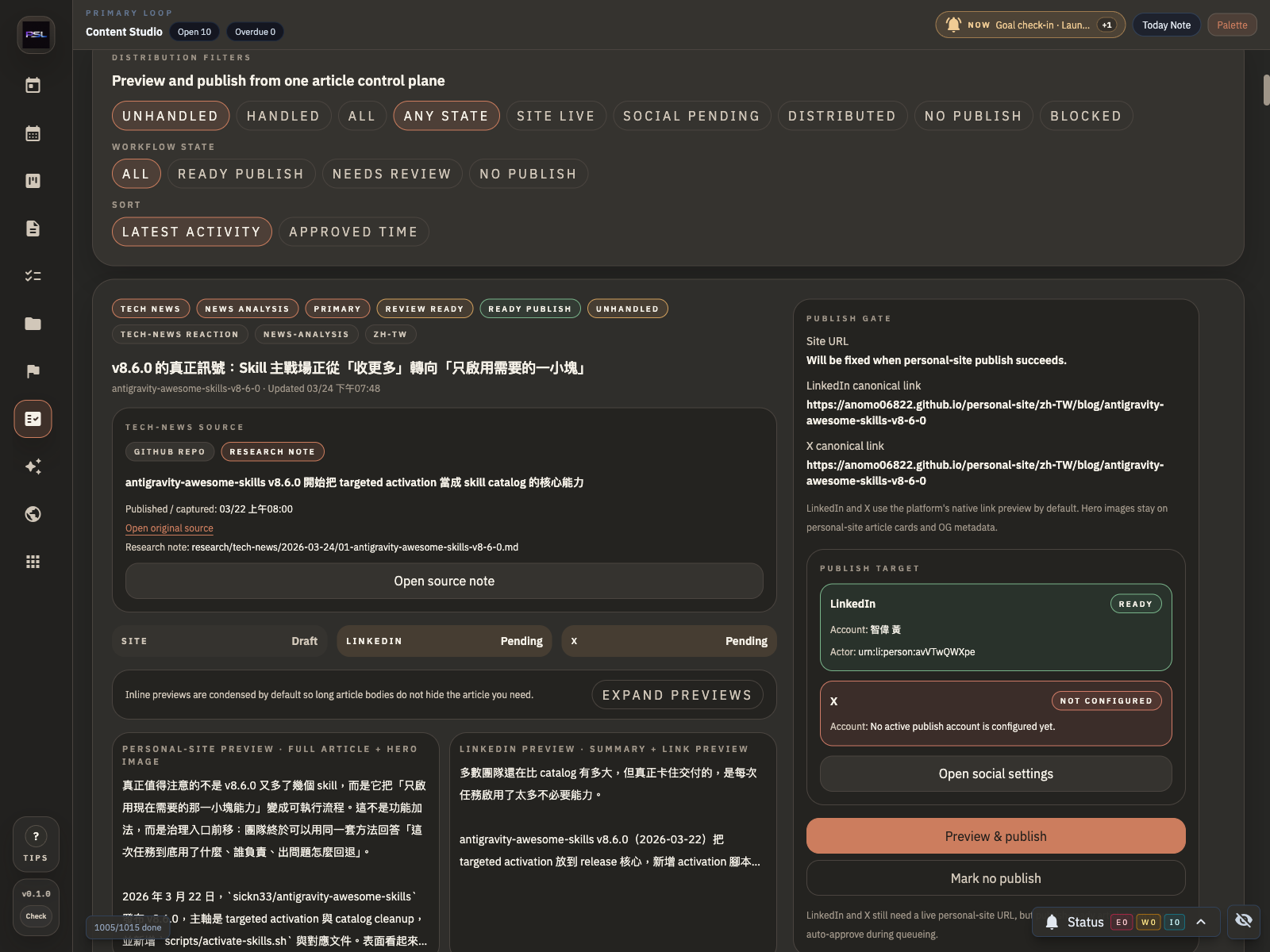
Distribution treats site publishing and social variants as coordinated surfaces of the same article, not as disconnected follow-up tasks.
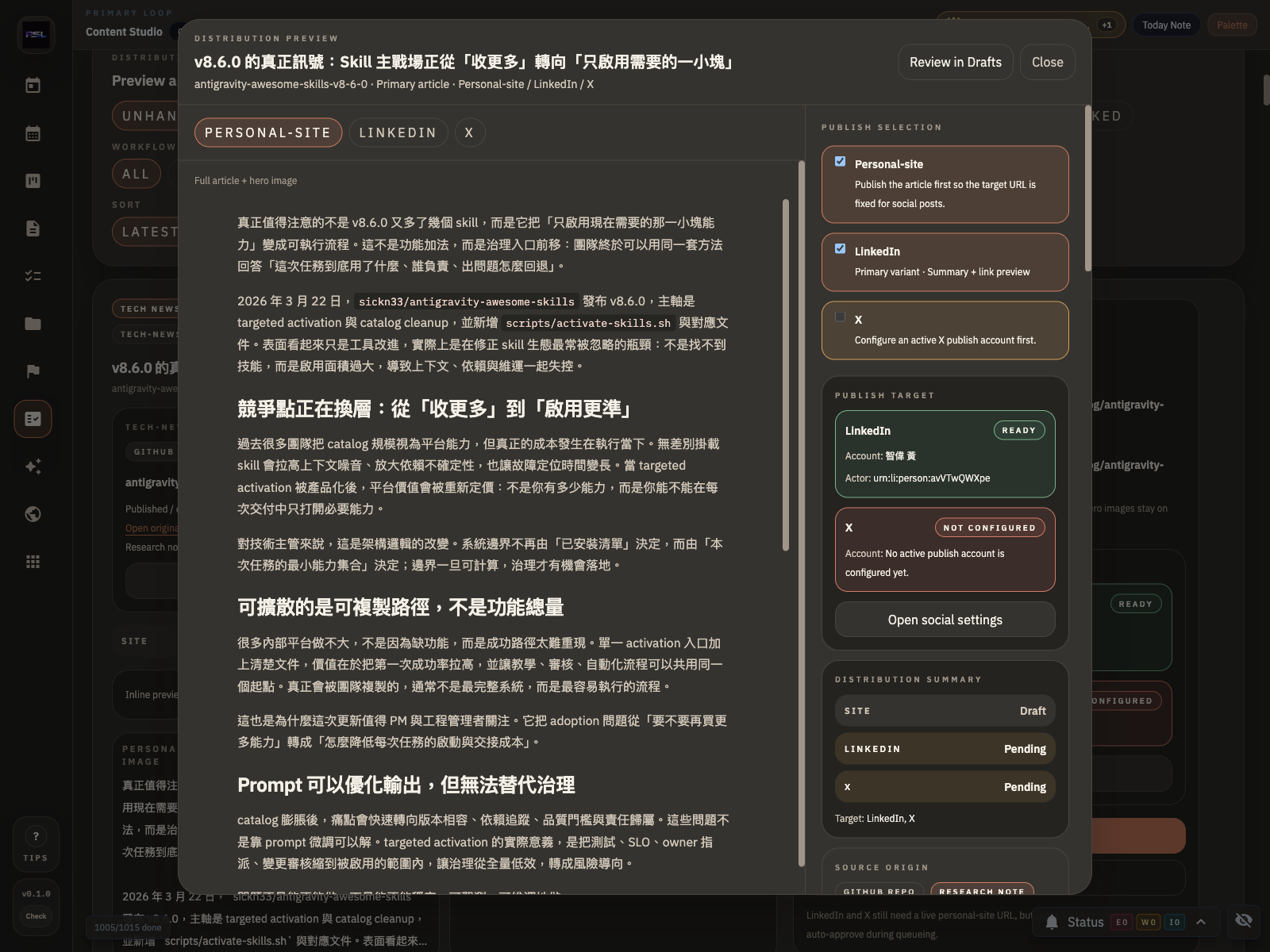
The distribution modal pulls canonical URL, publish targets, platform readiness, preview state, and image selection into one publish decision.
Performance matters because it turns publishing into a loop instead of an endpoint. Once article rollups, refresh state, and feedback signals return to the same control surface, editorial decisions can improve based on observed outcomes rather than memory and instinct.
Without readback, a content system only helps produce. With readback, it can start to optimize.
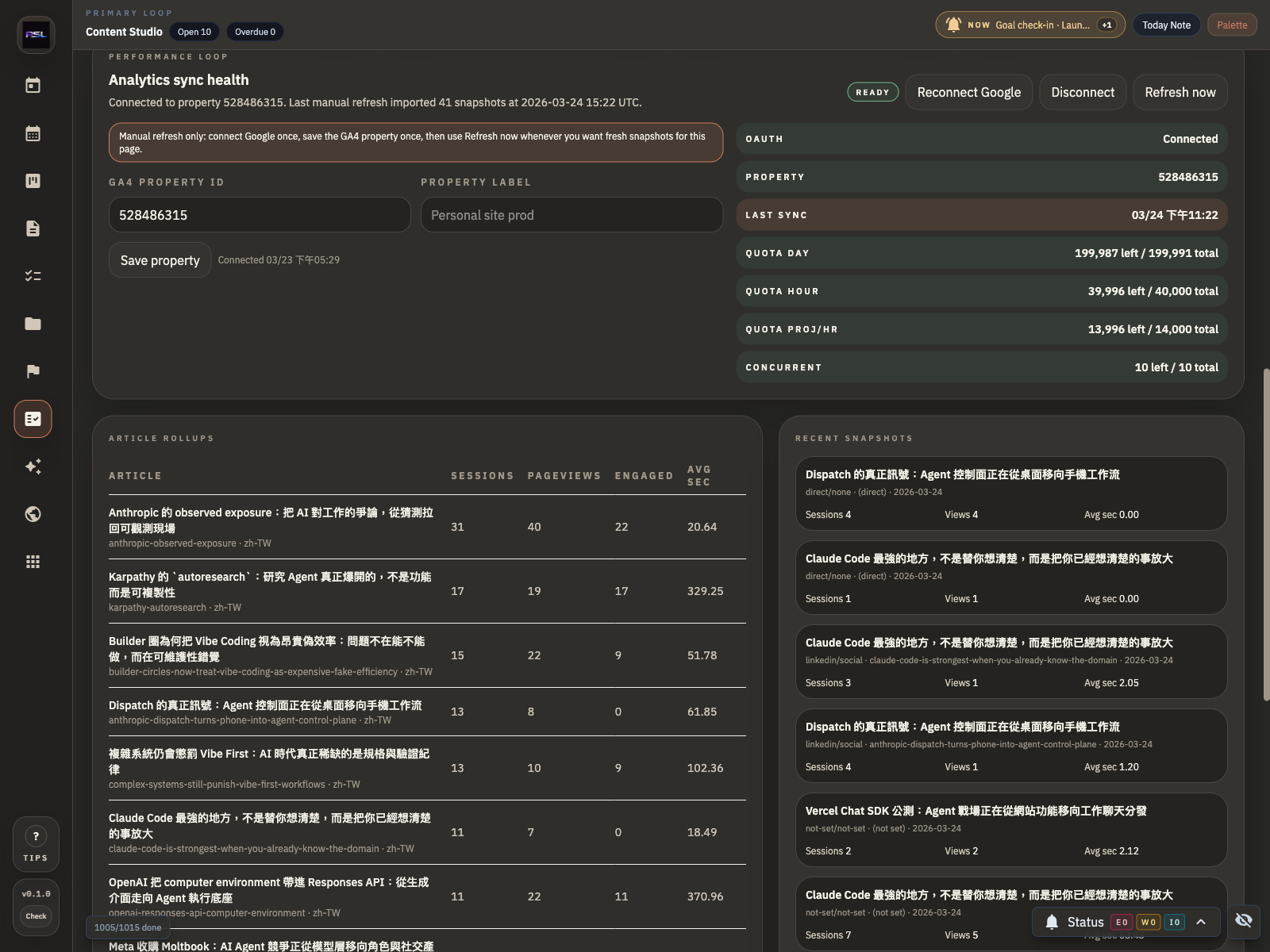
Performance brings GA4 property state, manual refresh, quota visibility, and article rollups back into the same operational loop.
Second-order effects for teams
The main impact is not “writing faster.” The deeper impact is that content operations begin to inherit the properties of an engineering system.
First, adoption cost goes up. You are not only adding a model. You are defining contracts, gates, ownership, and metrics.
Second, operability improves. Sources, drafts, distribution, and performance finally share context, which reduces the time spent chasing state across tools.
Third, observability becomes real. When article, job, draft, publish state, and performance all belong to the same workflow, teams can diagnose where a problem actually sits.
Fourth, ownership becomes clearer. Automation, editorial work, distribution, and analytics no longer blur into one ambiguous process.
Adoption advice
If you want to apply this model in your own system, the rollout order matters more than the feature list:
- Lock the upstream contract first. Do not optimize prompts before automation output is replayable, sync-safe, and auditable.
- Separate shortlist from drafting. Signals should not jump straight into article generation.
- Define the canonical publishing surface early. For AIPW, that is personal-site. Social should derive from the article, not evolve separately.
- Connect performance readback last. Analytics without stable slugs, URLs, and publish state will mostly create noise.
The point is not to build everything at once. The point is to strengthen the parts of the workflow that distort the fastest.
Risks and limits
This approach is not a shortcut.
The first cost is operational weight. Once the process becomes more structured, maintenance overhead goes up too. Teams without a stable editorial rhythm may feel the system becoming heavier before they feel the benefits.
The second limit is signal quality. A clean contract does not guarantee a strong topic.
The third limit is scope. Making personal-site the canonical surface improves focus, but it also means the system is optimized for a specific publishing model rather than a generic multi-brand CMS.
The fourth limit is analytics interpretation. Performance readback is necessary, but it is still only one part of content value.
Final take
What AIPW really built is not another AI editor. It built a governed delivery path for content.
Once automation, intake, drafting, distribution, and performance all converge on the same article state, personal-site growth starts to behave like product operations rather than a chain of manual content tasks.
The real signal is not another generation button. It is that content finally has a control plane.
Continue with related articles and stay within the same technical thread.
Three loops for AI agents: ReAct, Reflexion, and Generative Agents
Reading ReAct, Reflexion, and Generative Agents through actions, feedback, and memory, with practical checks for a research-to-publication workflow.
Simplifying My AI Workflow: Clear Ownership for Knowledge, Work, and Publishing
How I am retiring my custom Content Studio and assigning clear roles to Zotero, Heptabase, Linear, Codex, and Git, with complete article and image review before publication.
What is truly scarce in the AI era is not answers, but questions written into acceptable specifications
Models make it cheap to generate answers and make it easier for teams to move quickly in the wrong direction. To transform AI from a chat tool into a delivery capability, the key is not to accumulate more prompts, but to establish versionable problem specifications, information gap management, and verification loops.