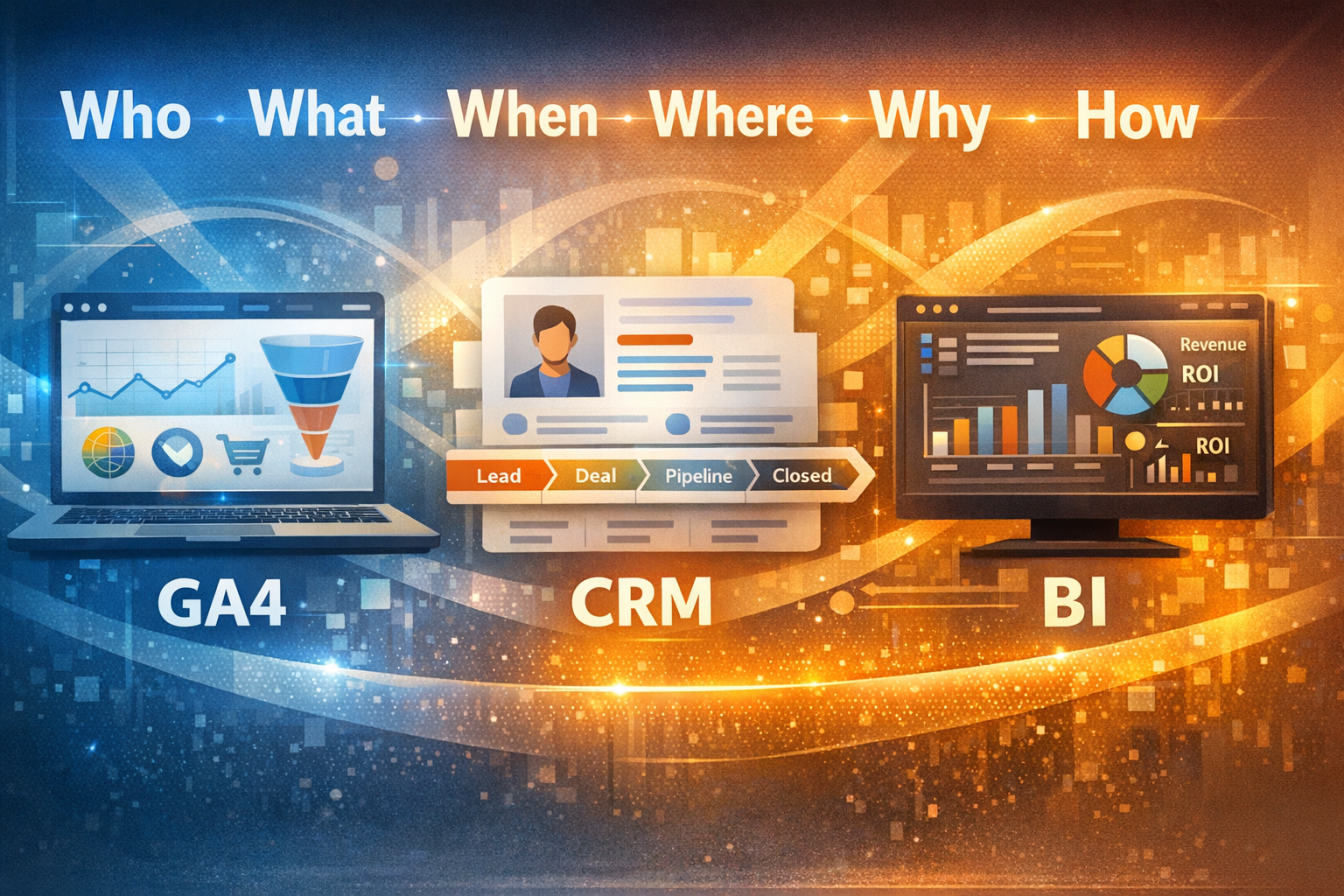
GA4, CRM, and BI are not a matter of choosing one of the three: first clearly distinguish the three-level issues of behavior, customers, and operations, and then talk about the data closed loop
Don’t ask first which set of tools is better, but first ask whether you want to answer behavioral, customer or business questions, and then string the three together into a data relay chain.
This article started as an AI-generated draft and was reviewed before publication.
TL;DR
GA4, CRM, and BI are often compared together, but they are not actually answering the same question. GA4 looks at traffic and on-site behavior, CRM manages customers and business opportunity progress, and BI integrates GA4, CRM, advertising, ERP and other data into the business decision-making layer. What really matters is not which set of tools is stronger, but which layer you are currently stuck on, and whether the data can be transferred from the previous layer to the next layer. For most teams, the mature approach is not to choose one of the three, but to layer first and then relay.
what happened
In many companies, when someone says they need to "do data well," the first action is often to make a tool comparison table: GA4 can monitor traffic, CRM can manage customers, and BI can produce reports. Then they start asking which one is the most important, which one to buy first, and which one has more functions.
This question itself has its own problems. Because these three systems are not competing products at the same level, but three working systems with different problem levels. If you put them in the same box and compare them, it is easy to end up with three misalignments: using GA4 to answer customer follow-up questions, using CRM to answer overall investment return questions, or doing BI prematurely without even unifying the most basic event naming, UTM, and business opportunity stages.
Why is this worth noting?
What's really worth noting is not the list of features, but the hierarchy of management issues. The difference between GA4, CRM, and BI is not only in the appearance of the reports, but also in the data granularity, update rhythm, responsible owner, and meeting rhythm they look at.
If you put it back into the team's daily routine, the first question you should ask is not "which one is stronger", but:
- What you want to know now is how people enter the station and where they leave?
- Still want to know who is on this list, who is following up now, and where are the business opportunities?
- Or do you actually care about whether the overall revenue, CAC, Win rate, and ROI meet the standards?
These three issues don't have the same best picture. The truly effective approach is to return problems at different levels to the corresponding systems and then connect them into a closed data loop.
Insight 1
**The core difference between GA4, CRM, and BI is not the tool function, but the problem level. **
The task of GA4 is to answer "what happened". It looks at sources, events, paths, funnels, conversions, and is usually geared toward anonymous or semi-anonymous behavioral data. It is suitable to be used to find stuck points on the site, such as which source of incoming traffic has higher quality, which page loses conversions, and which activity page leads to an increase in the purchase rate.
The task of CRM is to answer "Where is this customer now?" It looks at lead, contact, account, deal, task, and activity, which are objects that have entered the organization's follow-up process. Its value is not in the overall picture of traffic, but in tying people and subsequent actions to prevent lists from being scattered in mailboxes, spreadsheets, LINE groups and personal memories.
The task of BI is to answer "Is the overall business good or not?" It should not just be a relatively beautiful chart tool, but organize GA4, CRM, advertising, ERP, finance and other data into the same KPI context, allowing supervisors to make decisions in weekly meetings, monthly meetings, and budget meetings. It doesn’t look at a single event, or a single customer, but at a layer of results across systems.
Insight 2
**The data granularity, delay and owner of the three systems are different, so they should not be shouldered by the same kind of meeting or the same role. **
GA4 is event-level and behavioral-level data, which usually updates quickly and is suitable for marketing, growth, and quick confirmation of problems after product launch, revision, and activity launch. You don’t need to know who the person is first, it’s enough to know what he did.
CRM is entity- and process-level data. The rhythm is not so real-time, but it is very important for follow-up and execution. The business manager will not focus on the GA4 funnel every day to chase people. He cares more about whether the owner has received the list, what is the next step, and whether the business opportunity has been stuck at a certain stage for too long.
BI is indicator-level and governance-level data. It is usually built on data warehousing or at least cross-source consolidation, so the update rhythm is more like a daily, weekly, or monthly report. This is not a shortcoming, but its positioning. Executives should not be forced to find total revenue in GA4 discovery reports, nor should they be forced to calculate CAC by hand in a CRM checklist. That’s the responsibility that BI takes on.
This means ownership should also be clearly distinguished: GA4 is often maintained by marketing/growth/product, CRM is maintained by business/CSM/customer service leaders, and BI is usually defined by RevOps, analysts or data teams and management. If the owner is not clearly distinguished, no matter how many reports are made, it will just shift the blame.
Insight 3
**The mature approach is not to cram all problems into one tool, but to string three systems into a data relay chain. **
What will really bring value is not just looking at GA4, just looking at CRM, or just looking at BI, but knowing how to relay data. Ideally, the source quality and funnel points of traffic and events are first identified in GA4; when the list comes in or enters the sales process, CRM takes over the management of people and business opportunities; finally, the traffic sources, transaction results, and revenue costs are pulled together into BI to see which channel brings high-value customers and which process link is dragging down the overall performance.
The really difficult part of this chain is not the visual aspect of the report, but the definition and mapping. UTMs are not unified, event naming is messed up, lead sources cannot be traced, CRM stages are unclearly defined, and revenue recognition rules are inconsistent. In the end, no matter how beautiful the BI is, it just magnifies the wrong numbers.
So this matter is important, not because you can finally do more dashboards, but because you can finally answer a complete chain of questions: who came, what was done, who was followed up, whether there was a deal in the end, and whether this business is worth investing in again.
Second-order impact on engineering and delivery
From an engineering and delivery perspective, the differences between GA4, CRM, and BI will eventually turn into five practical issues.
The first is adoption cost. GA4 must first organize event taxonomy, conversion definitions and UTM rules; CRM must first define pipeline, owner, SLA, and next action; BI must first clarify dimensions, fact tables, and KPI calibers. Without these preparatory work, the tool going online will only digitize the chaos.
The second is operability. Who is responsible for fixing broken tracking? Who is responsible for correcting errors at the opportunity stage? Who is responsible for confirming that the revenue caliber is consistent before the monthly meeting? If these responsibilities do not have a clear owner, the most common thing that happens in the end is not "can't see the numbers" but "everyone has the numbers, but no one believes it."
The third is observability. The observability of GA4 lies in funnels, paths, and events; the observability of CRM lies in owner, stage, task, and activity; the observability of BI lies in KPI drift, ROI, and forecast. These observation points are different from each other and should not be hard-joined into the same dashboard thinking.
The fourth is cognitive load. Senior executives should not look for answers in the event stream every day, and business owners should not open ten BI dashboards to know who they should follow today. Each layer must have corresponding images and rhythm, otherwise the cognitive burden will be passed on to the user.
The fifth is ownership boundary. GA4, CRM, and BI are not questions about internal friction of "who is more important?" but questions about whether the boundaries between different teams are clear. Once the boundaries are blurred, the import sequence, KPIs, data quality and meeting rhythm will be messed up.
My adoption advice
Suitable for whom
- Teams that have official website or app traffic and want to know which sources and pages are driving conversions should first get GA4 right.
- For teams with business follow-up, list cultivation, renewal management, or customer service tracking processes, CRM is almost a necessary infrastructure.
- For teams that already need to put traffic, business opportunities, revenue, and costs in the same management context, it only makes sense to introduce BI.
How to start
- Define the problem first, then choose tools. Don’t buy a platform first and then look back for demand.
- Get the core definition right first. GA4 first has KPIs, UTMs, events and conversions; CRM first has stages, owners, and SLAs; BI first has unified calibers and main dimensions.
- Connect the shortest closed loop first. For most teams, it is usually the line of "source -> conversion -> lead -> deal -> revenue" instead of integrating all data sources at once.
- Meeting pacing also needs to be layered. We will read GA4 + CRM every week and BI every month. Don’t use the same report for all decisions.
Don't do anything for now
- Don’t rush into a large BI project when event naming and lead sources are not yet stable.
- Don’t think of CRM as a behavioral analysis tool, and don’t think of GA4 as a customer master file.
- Don't think of the dashboard as the answer itself. Reports are only decision-making interfaces, not governance substitutes.
Risks and Limitations
The biggest risk is not that the tools are not powerful enough, but that the definitions are inconsistent. GA4's UTM is messy, CRM's owner rules are vague, and BI's revenue calculus is multi-versioned. In the end, the same question will get three answers in three systems.
The second risk is premature integration. Many teams are rushing to build cross-system dashboards before the quality of basic data has been established. The result is that errors are synchronized to more places. BI amplifies value and also amplifies the mistakes of the first two layers.
The third limitation is identity concatenation. GA4 often sees behaviors, not necessarily people; CRM often records people, but it may not be able to fully trace front-end behaviors. Without reasonable source mapping and data strategies, it will be difficult to truly connect source quality and transaction results.
final judgment
GA4 manages visible behaviors, CRM manages people who need to be followed up, and BI manages results that need to be managed. A truly mature team does not choose one set of solutions as a universal answer, but first distinguishes the levels of the problem and then connects the three into a manageable data chain. Layering first, and then relaying, is far more important than "buying it all at once".
Further reading/CTA
- You can extend it to the next article:
UTM、事件命名、商機階段,為什麼是資料閉環的三個最小前提 - You can extend it to the next article:
RevOps 為什麼不是工具採購,而是資料與流程的接縫工程 - CTA suggestion: If you are currently struggling with "there are many reports, but it is still difficult to make decisions", first take stock of whether the team is currently dealing with behavioral, customer, or management issues.
If this article ships with a deck, template, or supplemental file, it will appear here.
Continue with related articles and stay within the same technical thread.
What is truly scarce in the AI era is not answers, but questions written into acceptable specifications
Models make it cheap to generate answers and make it easier for teams to move quickly in the wrong direction. To transform AI from a chat tool into a delivery capability, the key is not to accumulate more prompts, but to establish versionable problem specifications, information gap management, and verification loops.
Deep communication leadership: What supervisors need to design is a feedback system, not more beautiful words
An effective feedback must not only make people willing to tell the truth, but also keep facts, boundaries and commitments in the system. From a sense of security and specific behaviors to dynamic switching of guidance and teaching, this is a management loop that can be tracked, debugged and continuously improved.
AI coding speed is not the moat, delivery rhythm is: looking at the productization boundary of agentic workflow from Superpowers
GitHub Superpowers' process adjustment on 2026-03-24 revealed that the core battlefield of agentic development has shifted from model performance to process governance. The truly replicable advantage is to turn spec to release into an observable, replayable, and signable delivery rhythm.