Vercel Chat SDK open beta: Agent battlefield is moving from website functionality to work chat distribution
The real value of Vercel Chat SDK is not to build another bot framework, but to standardize the cost of cross-platform distribution, allowing the team to more quickly verify which chat portals are worthy of long-term investment.
This article started as an AI-generated draft and was reviewed before publication.
TL;DR
The Vercel Chat SDK public beta turns bot development across Slack, Teams, and Discord from multiple adapter projects into a single TypeScript runtime problem. What's really worth noting is not writing fewer pieces of integration code, but turning agent distribution into a programmable and iterable product capability. For B2B teams, this is a good time to quickly pilot multiple platforms; however, differences in platform policies and interactive semantics will still determine whether you can go online stably.
what happened
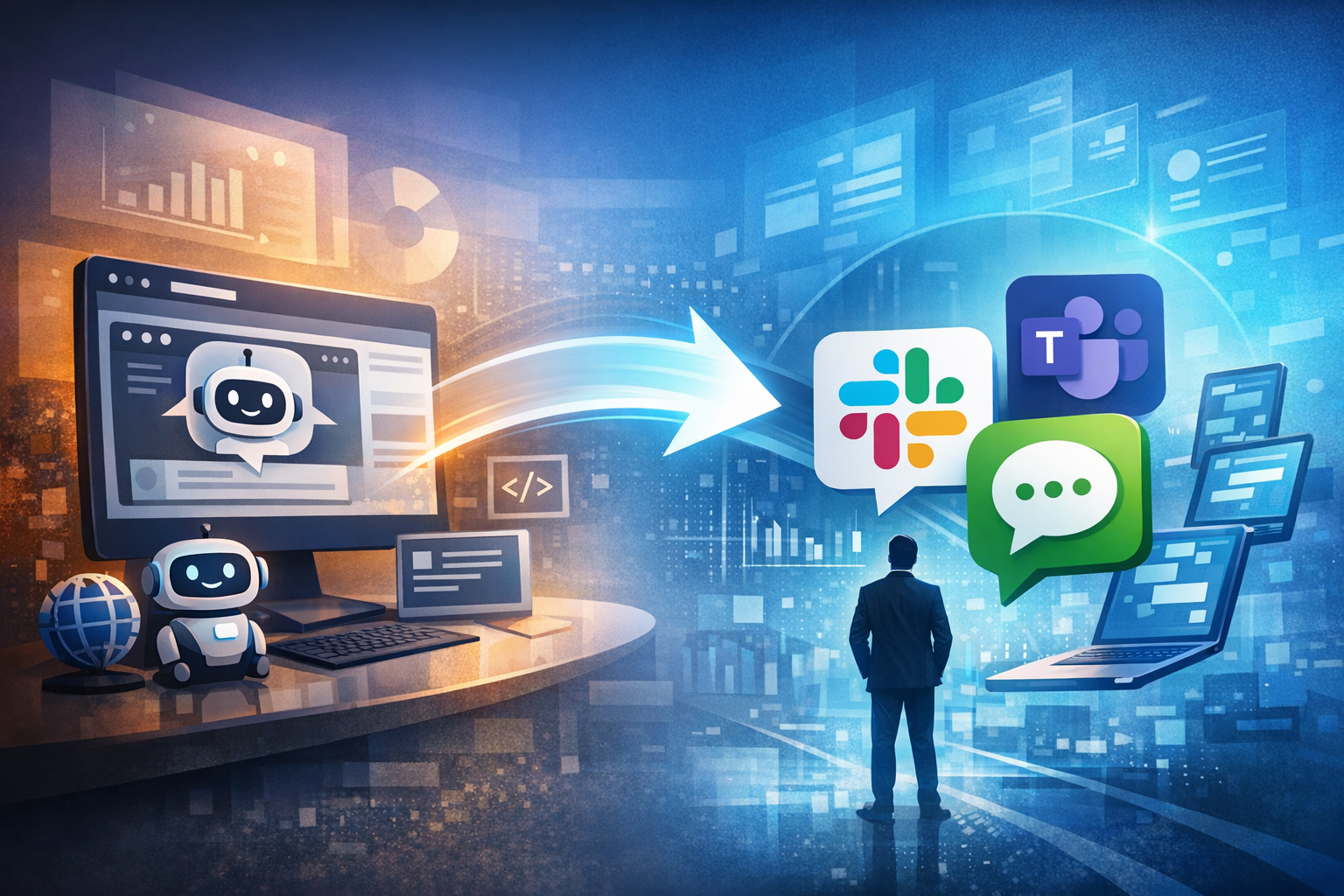
On 2026-02-24, Vercel announced on Changelog that Chat SDK is open source as public beta. The official positioning is "write bot logic once and deploy to multiple chat platforms", and attempts to unify auth, events, message format and state handling. The news spread quickly because everyone has seen: the agent will not only stay in .com, it will be used frequently only when it enters the team's native collaboration interface.
Why is this worth noting?
This is important not because of the functionality itself, but because it condenses a long-dispersed and repetitive engineering problem into a reusable runtime abstraction. When cross-platform integration changes from a customized project to a basic capability, the team can shift resources from "connecting to the platform" to "creating sustainable workflow value". The point of competition is shifting from single-point model capabilities to who can deliver capabilities into real collaboration contexts faster.
Insight 1 — Insight 1: The competition layer moves from model presentation to distribution runtime
**The really important thing is not to have one more bot SDK, but to turn cross-platform access costs into predictable engineering costs. **
In the past, most teams built adapters for each chat platform and repeatedly processed event models, verification processes, and message encapsulation. These efforts rarely result in product differentiation but chronically slow delivery.
Vercel converges this layer into the same runtime, which means you can change the architectural boundary from "platform customization" to "core capabilities + connector policy", making cross-platform support no longer a one-time project, but a continuously evolving basic layer.
- Implication: Engineering and products can conduct multiple surface pilots on the same set of domain logic, shortening the iteration cycle from requirements to observable adoption data.
Insight 2 — Insight 2: Diffusion comes from replicable interfaces, not full functionality
**What will really be copied is usually not the most complete system, but the system that is easiest to understand and easiest to call out. **
Most of the agents that are actually used in enterprises today are agents that can be directly embedded into existing chat processes, rather than agents that can only be found at the website entrance. This is also the core reason for the rapid spread of Chat SDK: it allows the team to shift their focus from a single point of experience to cross-scenario reach and call costs.
If you put it back into product decisions, the first question you should ask is "Which chat triggers can continue to generate workflow value" rather than "Do we support the most platforms?"
- Implication: Roadmap needs to include "cost of being called" and "speed of entering existing processes" as first-level indicators, rather than just evaluating response quality.
Insight 3 — Insight 3: Unified runtime only solves 80%, the last 20% is still a platform reality
**The question is not whether it can be done, but whether it can be done stably, observably, and maintainably. **
Slack, Teams, Discord, and GitHub are all inconsistent in terms of permission models, event semantics, review processes, and rate limits. Unifying the runtime can reduce duplication of development, but it cannot eliminate platform governance differences.
If the team misinterprets "unification" as "complete homogeneity", they will discover interaction gaps, insufficient error fallback strategies, and even compliance blocking only in production, and finally the core logic will be contaminated by exception conditions.
- Implication: The architecture must reserve a per-surface policy layer, platform exception process, and fallback mechanism to avoid forcing differences into core business logic.
Second-order impact on engineering and delivery
Putting this back into engineering and delivery, there are at least six second-order impacts:
- Adoption cost: PoC becomes cheaper, but production still requires platform permissions and legal review, and early governance costs cannot be omitted.
- Operability: Multiple platforms allow the accident area to be enlarged, and on-call requires cross-platform runbooks and unified alarm design.
- Observability / Debugability: Cross-platform trace IDs, event labels, and error classifications must be established to quickly distinguish core logic problems or connector problems.
- Cognitive load: PMs and engineers need to master "common processes" and "platform exceptions" at the same time, which increases the cost of knowledge maintenance.
- Ownership boundary: The responsibility boundaries between the platform integration layer, product process layer, and model strategy layer must be clearly defined in advance.
- Evaluation burden: Verification not only looks at the quality of the answer, but also looks at the trigger success rate, delay, rollback experience and cross-platform consistency.
My adoption advice
It is recommended to adopt three stages rather than all at once: The first stage (2-4 weeks): Select two high-frequency scenarios and two chat platforms to conduct minimum usable pilots, such as incident triage and internal knowledge query. The second stage: Complete the observation and maintenance foundation, define per-surface SLA, error code classification, rate-limit rollback and permission failure handling. The third stage: decide whether to expand to the third platform based on adoption data, and modularize the connector policy to ensure that the core logic is not contaminated by platform differences. The decision-making threshold should be "cross-platform faults can be located and restored within 30 minutes" rather than "function demo can be run".
Risks and Limitations
There are four main limitations. First, platform policies and review rhythms are different, which will cause time differences when the same function is launched on different platforms. Second, differences in permission models may make the same workflow feasible on a certain platform but distorted across platforms.第三,rate limit 与互动语意差异会直接影响体验一致性。 Fourth, the interface in the public beta stage may still change. If the core process is over-bound, subsequent migration costs will rise rapidly.
final judgment
"The value of a unified runtime is not to allow you to write for all platforms at once, but to allow you to use the same set of core logic to quickly determine which chat portal is worthy of long-term investment." By treating the Chat SDK as a distribution hypothesis verifier, you will get more robust results than "all platforms go online at the same time."
Further reading/CTA
If you are doing a B2B agent or team-facing workflow, first list the first three chat surfaces you want to serve, split the common core and platform exceptions, and then decide how deep to invest. The complete analysis and subsequent actual measurements will be updated at: https://anomo06822.github.io/personal-site/zh-TW/blog/vercel-chat-sdk-public-beta
Sources and References
Continue with related articles and stay within the same technical thread.
Copilot Code Review enters the Agentic stage: the real upgrade is the context, not the number of comments
What really changes in this GitHub upgrade is not the number of comments, but the understanding process before commenting: context-aware review will become the basic threshold for the next stage of AI code review.
Agency-agents on GitHub became popular: What was really productized was not Prompt, but the distribution layer of AI Team Roster
The real signal of `agency-agents` is not "another bunch of AI role prompts", but that the agent circle has begun to make "expert specifications + cross-tool distribution + collaborative narrative" into a reusable product.
After GitHub turned Figma MCP into a two-way loop, the watershed of design-to-code is no longer coding.
What is really noteworthy is not the writeback function itself, but that it pulls the design and code back into the same traceable artifact chain, allowing the team to systematically handle drift, conflicts, and delivery consistency.