ai-productivity-workspace
Private GitHub repository
A desktop productivity workspace built with Electron, React, and .NET 10 that brings notes, boards, task management, agent dispatch, world simulation, and a governed tech-news-to-distribution content lane into one evolving product foundation.
Media
ai-productivity-workspace
A desktop productivity workspace built with Electron, React, and .NET 10 that brings notes, boards, task management, agent dispatch, world simulation, and a governed tech-news-to-distribution content lane into one evolving product foundation.
Current project media now mixes the refreshed AIPW media pack with one workflow blueprint: `01` to `05` are clean 2026-03-17 Claude Code theme screenshots, `07` is the 2026-03-19 tech-news workflow control-plane visual, plus the same 16-second world movement rerun.
16-second rerun demo that starts from a true lounge baseline, then re-dispatches PRD36, ARC36, and ENG36 to verify district movement, live status, and world feed behavior.
Tech-news workflow
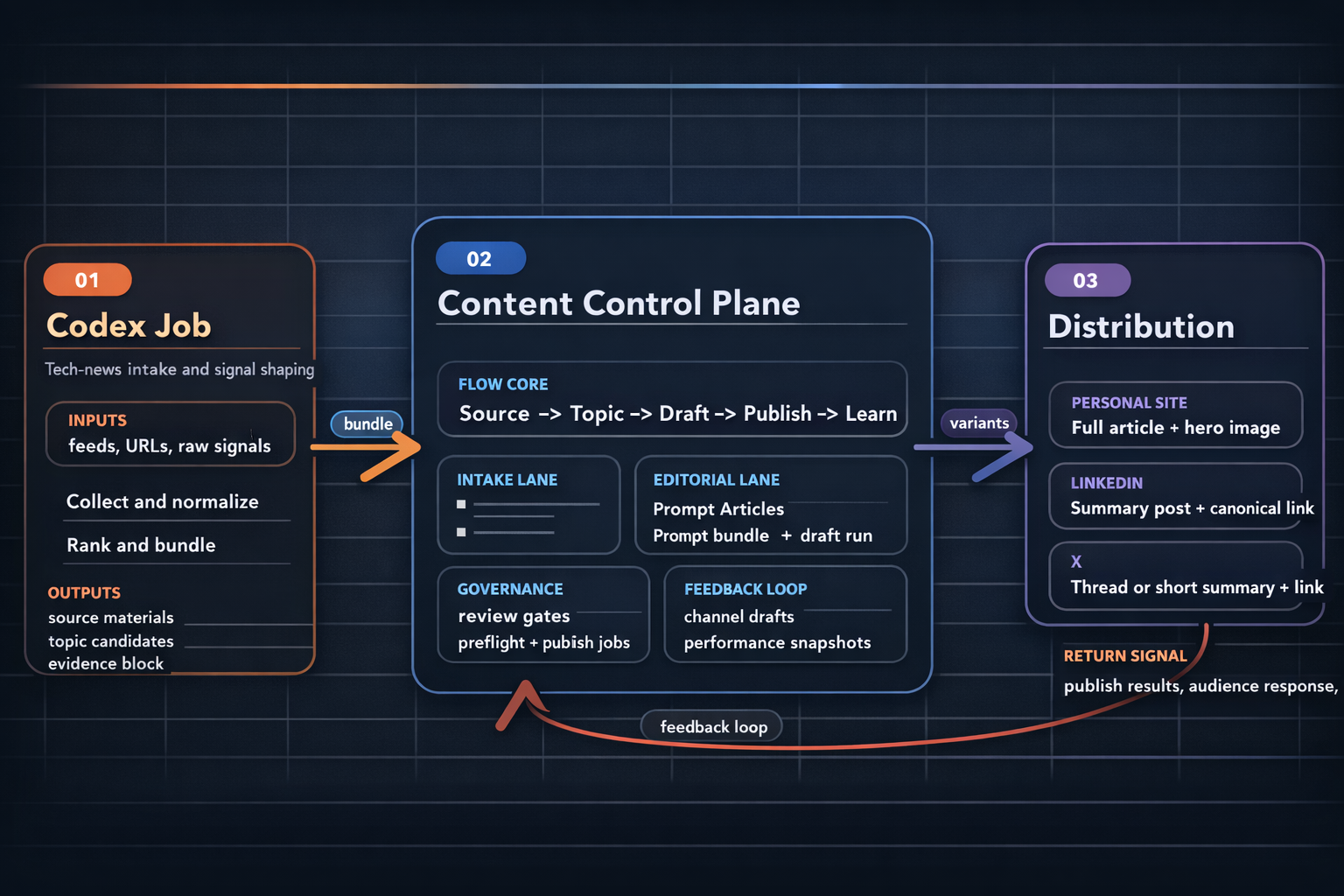
Claude Code-themed dark blueprint that explains the current operating model: Codex intake -> Content Control Plane -> Distribution -> feedback loop.
One of the more meaningful recent additions is not another AI writing screen, but a governed content workflow that connects research, editorial packaging, distribution, and learning inside the same product.
The lane starts before the editor. A Codex job ingests tech-news signals, normalizes feeds, URLs, and raw notes, and produces source materials, topic candidates, and evidence blocks that can be traced later.
Once the work enters AIPW, it lives inside an article-centric content control plane. Source materials, topic candidates, content articles, prompt bundles, channel drafts, publish jobs, and performance snapshots all share the same operating context instead of drifting across separate tools.
Distribution then follows channel semantics rather than copy-paste reuse. The personal site stays the full article + hero image surface, while LinkedIn and X default to summary-led posts that point back to the canonical article.
- personal-site: full article + hero image as the canonical publication surface.
- LinkedIn: summary post + canonical link with a professional distribution shape.
- X: thread or short summary + link for faster signal amplification.
- Feedback layer: publish status, channel outcomes, and performance signals feed the next editorial cycle.
Codex-driven signal intake
Tech-news signals are collected, normalized, and bundled first so drafting starts from structured evidence instead of loose links.
Article-centric editorial system
AIPW keeps source, topic, article, prompt bundle, review gate, and publish job inside one article lifecycle so the workflow stays traceable.
Channel semantics over copy-paste
Site, LinkedIn, and X each get their own output semantics, while channel drafts and publish payloads still stay bound to the same canonical article.
Publish and learning loop
Publish results, audience response, and performance snapshots return to the next round of topic judgment and editorial tuning.
Overview
A desktop productivity workspace built with Electron, React, and .NET 10 that brings notes, boards, task management, agent dispatch, world simulation, and a governed tech-news-to-distribution content lane into one evolving product foundation.
This project is not meant to be a single AI utility. It is a desktop workspace that keeps the daily loop of capture → decide → execute → review inside one product surface so notes, boards, tasks, content pipeline, and agent execution stay aligned.
The current product already exposes Workspace, Boards, Task Management, Agent Command Center, Content Studio, and Agent World as distinct but connected surfaces. The intent is not feature sprawl, but to keep daily planning, dispatch control, editorial workflow, and execution visibility inside the same operating shell.
One of the more public-facing recent evolutions is the tech-news lane: a Codex job handles signal intake first, then AIPW uses an article-centric control plane to manage topics, drafts, publish gates, and feedback before adapting the result to personal-site, LinkedIn, and X.
That makes personal-site growth part of the product itself rather than an external writing routine. Note-first research, review gates, channel drafts, publish jobs, and performance snapshots now fit inside the same operating model.
Electron provides the desktop shell, React + TypeScript + Tailwind v4 shape the frontend, and a .NET 10 vertical-slice API with EF Core PostgreSQL provides the data and workflow backbone. Local MCP and desktop-first development flow are part of the design so future AI-assisted workflows can plug into the same workspace cleanly.
- The same desktop shell already connects a note library, reusable templates, delivery / focus / portfolio boards, centralized task triage, and context rails so daily execution does not fragment across tools.
- Content Studio now turns Codex-led tech-news signal intake, topic shortlist, draft bundles, channel drafts, and publish / performance feedback into an article-centric control plane.
- Agent Command Center turns role binding, dispatch runs, timeline, artifacts, and intervention controls into an operable execution surface instead of hidden background automation.
- Agent World adds a pixel-art live office view for districts, staff distribution, focus / blocked / idle status, and rerun verification, while the product core stays on .NET 10 vertical-slice API, PostgreSQL, and local MCP integration.
Feedback
Feedback is not open for this project yet
This repository is not public yet. GitHub issue feedback will open after the public cleanup and release path are ready.