The real work of AI-driven leadership: Not buying new tools, but resetting the work system
Korn Ferry mentioned that only 22% of organizations believe they are ready for job redesign. What this signal really points to is not the maturity of tools, but that management tasks have been rewritten: the next wave of competition is in role design, verification links and closed loops of responsibility.
This article started as an AI-generated draft and was reviewed before publication.
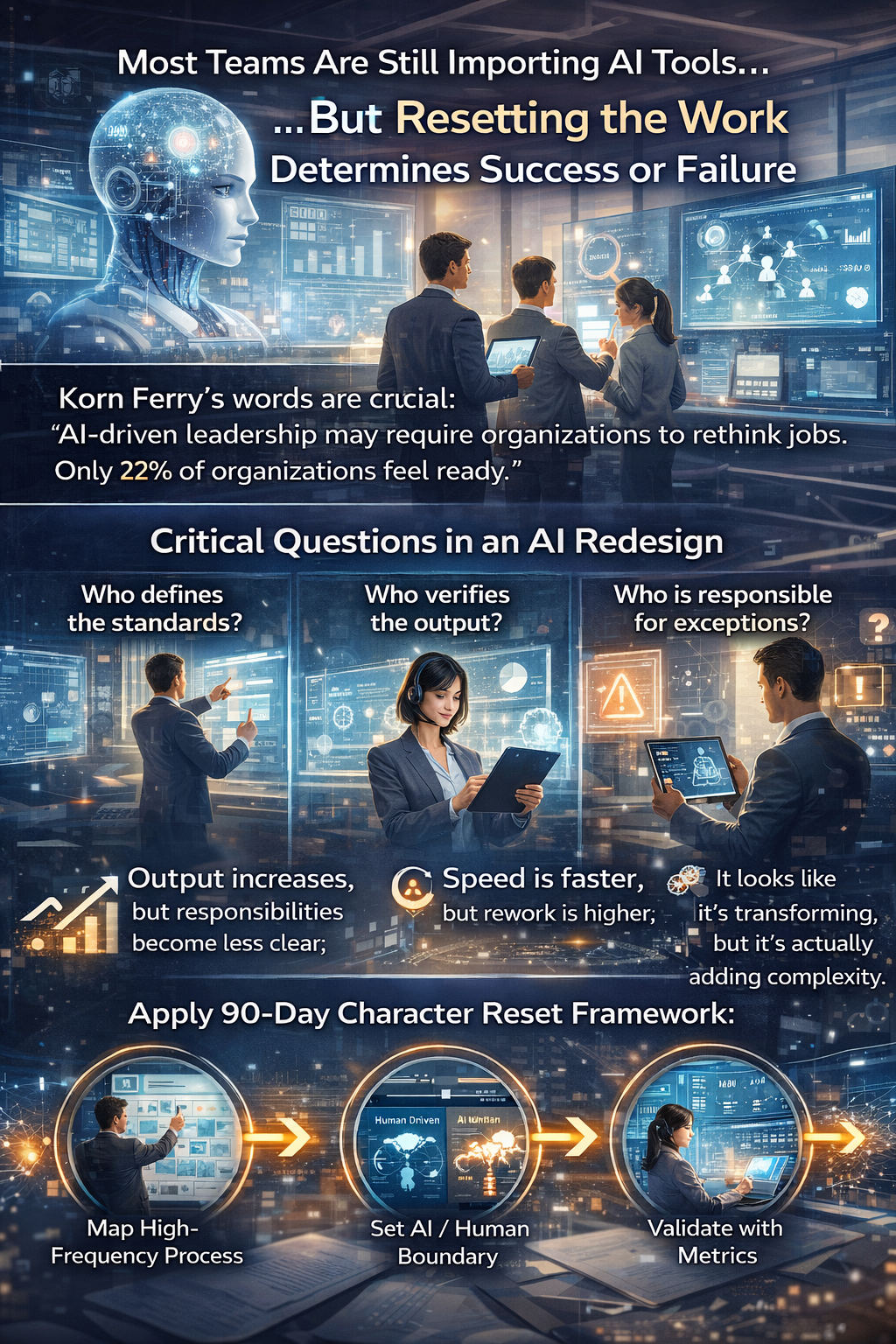
What is truly noteworthy is not that there is another AI tool, but that management has finally recast the question as "how can work be redesigned?" Korn Ferry proposed on LinkedIn that AI-driven leadership requires rethinking jobs, and only 22% of organizations believe they are ready to do job redesign. The significance of this number is not that who is lagging behind, but that most teams are still using tools to introduce thinking and answer a question that actually belongs to organizational design.
In the past two years, many companies have regarded the introduction of AI as a procurement and training task: selecting models, granting permissions, running courses, and looking at usage rates. These are necessary, but no longer sufficient. Because what really affects the quality of delivery is not "whether AI is used", but "which role makes the judgment at which node, who verifies, who signs off, and who bears the exception risk." When the decision-making unit changes from a tool to a job, the leader's KPIs will also change tracks.
The gap is not in the tool list, but in the role interface
Tool capabilities will become homogeneous quickly, and procurement advantages usually won’t last long. What is really difficult to replicate is how you break down a job into collaborative role interfaces: who defines the standards, who operates the model, who does the quality gatekeeping, and who is responsible for the results.
When teams take on new processes with old job descriptions, the most common outcome is that everyone generates content but no one is accountable for the results. On the surface, the speed becomes faster, but in fact the boundaries of responsibility are broken down, and rework and disputes will accumulate at the handover point.
For technical leads and PMs, the first thing to do is not a tool rating list, but a "role-responsibility-deliverable" map. This image is closer to make or break than any prompt template.
AI rearranges judgment and verification, not just efficiency
This matter is important not because the function is stronger, but because judgment and verification must be made explicit. Many jobs originally tied judgment and execution to the same role; after AI intervenes, execution is automated, and judgment and verification become new bottlenecks.
Without resetting the division of labor, the team will usually fall into two extremes: either over-delegating power to the model, causing quality drift; or returning to manual review at every step, causing throughput to collapse. The former will create risky debt, and the latter will create the illusion of efficiency. Both ultimately led to the AI project being labeled "unstable."
A more feasible approach is to clearly split the process into four stages: generation, review, sign-off, and feedback, and define the owner and upgrade conditions for each stage. The question is not whether it can be done, but whether it can be done stably, observably, and maintainably.
What will really spread is the replicable working module
What will really be copied is usually not the most complete transformation story, but the easiest to understand module that can be implemented within two weeks. For example, requirements clarification assistants, change impact assessments, customer service drafts plus manual review, these are all more diffuse than grand narratives.
This also explains why "job redesign" has become a management language. Rather than talking about an abstract vision, it forces teams to answer a very specific question: How can work be reorganized to balance speed, quality and responsibility.
The next step for the platform team should be to build an internal mod library. Each module must have at least inputs, outputs, success indicators, risk boundaries and owners. The more standardized a module is, the faster it will be replicated across departments.
Return to engineering and delivery, second-order impact is more critical
If you put it back into the team's daily routine, you should first ask about the costs and boundaries at the system level, rather than single-point efficiency improvements.
adoption cost: The main cost is not the license, but process rewriting, role training and governance mechanisms.operability: Without owner and upgrade path, the fault will be stuck at the cross-department boundary.observability/debugability: If the prompt version, data source, and manual intervention point cannot be tracked, review will be impossible.cognitive load: Unclear role definition will magnify communication costs and make "who should decide" become daily friction.ownership boundary: AI allows work to cross domains more frequently. If the lines of responsibility are not redrawn, conflicts will become normal.evaluation burden: Not only do you need to evaluate the model, but you also need to evaluate whether the new work design actually improves quality and cycle time.
An actionable 90-day adoption path
Doing it right on a small scale first and then expanding it is more pragmatic than rolling it out across the board.
- Days 1-30: Pick a high-frequency, measurable process that spans at least two roles, and take inventory of current decision points and responsibility breakpoints.
- Days 31-60: Reset the division of labor, clearly indicate "AI can be automated", "humans must judge" and "when to upgrade to manual work", and establish minimum indicators (cycle, rework rate, exception rate).
- Days 61-90: Encapsulate effective practices into module templates and copy them to the second process to avoid starting over every time.
The risk is not that the import is too slow, but that the change is half done
The most common risk is not that there is no call for transformation, but that the slogan comes first and the system lags behind. On the surface, we talk about job redesign, but in fact, the KPIs, rights and responsibilities, and review mechanisms have not been changed. In the end, it is just a matter of superimposing new tools on the old process.
Another high-risk area is changing only the frontend but not the backend. Output has become faster, but legal compliance, data management, and audit mechanisms are not synchronized. It looks good in the short term, but it will accumulate trust debt in the long term.
Furthermore, maturity levels vary widely across organizations. Teams with weak process assets and undefined management rhythm are not suitable for changing multiple core processes at the same time. Doing a single-point verifiable pilot first will lead to a replicable state faster.
final judgment
The watershed of AI leadership is not how many tools you introduce, but whether you can reset the work into a collaborative, verifiable, maintainable, and accountable system. The focus of competition is shifting from tool procurement to process observability and role design capabilities.
Sources and References
- The real job of AI-driven leadership has become job redesign, not buying another tool · Linkedin · 2026-03-23
Continue with related articles and stay within the same technical thread.
When the HR Operator starts organizing AI, the organizational absorption phase has already begun
A recent AI reading list on LinkedIn led by talent and HR operators is translating technical signals into management language. This is not just a collection of information, but a clear sign that companies are beginning to use policies, processes, and responsibility frameworks to absorb AI.
The real signal from Dispatch: Agent control plane is moving from desktop to mobile workflow
Anthropic's Dispatch seems to be just another mobile phone portal, but what actually changes is the rhythm of agent use and the division of organizational responsibilities. When delegation becomes instant, governance gaps will be magnified in advance; teams must first make up for permissions, status visibility, and takeover mechanisms, rather than rushing to pursue higher automation coverage.
The real leverage of Claude Code: not to judge for you, but to amplify the judgment you have already made correctly
The difference in the effectiveness of Claude Code's import is often not in the model itself, but in whether the team first defines task boundaries and verification mechanisms. When the problem is verifiable, AI coding will bring stable throughput; when demand still drifts, the speed will quickly turn into review and rework debt.