The real signal from Dispatch: Agent control plane is moving from desktop to mobile workflow
Anthropic's Dispatch seems to be just another mobile phone portal, but what actually changes is the rhythm of agent use and the division of organizational responsibilities. When delegation becomes instant, governance gaps will be magnified in advance; teams must first make up for permissions, status visibility, and takeover mechanisms, rather than rushing to pursue higher automation coverage.
This article started as an AI-generated draft and was reviewed before publication.
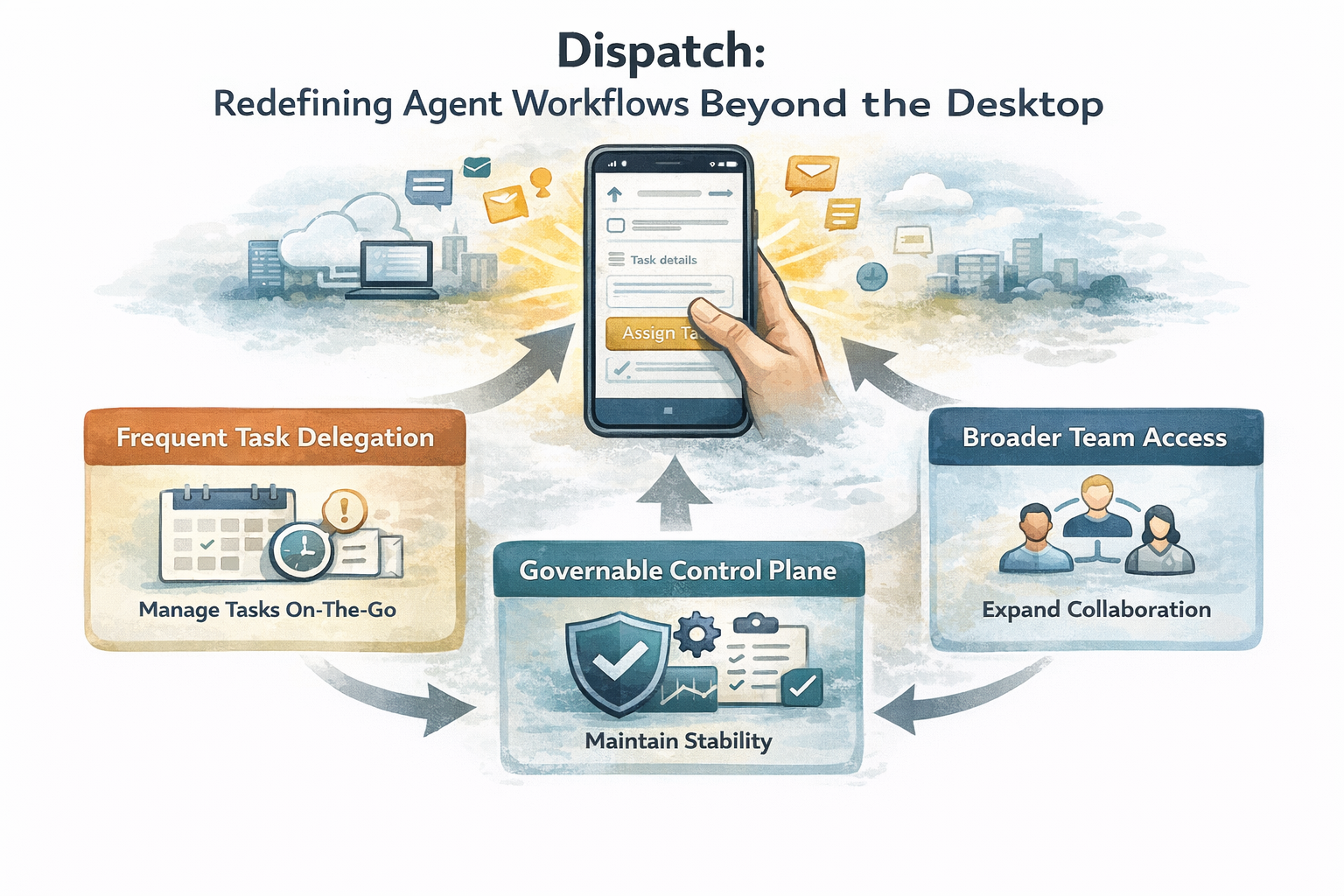
What is really worth noting is not that Dispatch allows you to remotely control the desktop on your mobile phone, but that it moves the control surface of the agent from "sit down to use" to a "ready to use" workflow. Once the position of the control surface changes, the adoption logic will be rewritten: tasks are dispatched more frequently, the response rhythm is more fragmented, and the boundaries of responsibility are easier to lose focus.
Anthropic connects Dispatch and computer use this time, which looks like a functional extension, but is actually a revision of the work coordination model. In the past, we often asked "Can the model do it?"; the next more critical thing is "Can the task be stably assigned, tracked, taken over and audited?" This matter is important not because there is one more terminal, but because it shifts the point of competition from model capabilities to control plane portability and governance capabilities.
The entrance position is changed, and the team rhythm is rewritten first.
When the task entry is transferred from the desktop to the mobile phone, the use of the agent is no longer bound to the complete concentration period, but penetrates into the gaps between meetings, during commuting, and before and after cross-time zone handovers. This will directly increase the frequency of task delegation, but it will also increase the cost of midway intervention and priority switching.
The question is not whether it can be done, but whether it can be done stably, observably, and maintainably. Without a clear task state machine (such as queued, running, needs-input, done), the mobile version will only amplify the notification noise, making the team think that the progress is progressing, but in fact it is just information flowing.
What will spread is not the strongest ability, but the process that is easiest to take over.
What will really be copied is usually not the most complete system, but the system that is easiest to understand and take over. The mobile control surface allows agents to move from a tool for a few experts to daily collaboration across roles; the speed of diffusion therefore depends on the degree of process templates rather than the impressive results of a single demo.
This means that the product and platform teams should focus on "teachability, reusability, and handover": task templates, standard output formats, minimum operation manuals, and takeover paths after failure. If new members cannot take over in a short period of time, scaling will only lead to more half-finished tasks.
The point of competition is shifting: from model performance to governance capabilities
When mobile phones become the control surface, triggering cost reduction, governance gaps will be exposed more quickly: who can dispatch workers, who can change parameters, who can interrupt, and who is responsible for the results. If these boundaries are unclear, organizations will simply get tasks delivered faster, rather than a more reliable execution system.
Cross-device operations also increase auditing requirements. Without an end-to-end event trace, it is difficult to answer three basic questions after an incident: what happened, who did what, and why. This is not just a security issue, but also a matter of delivery credibility and management defensibility.
Returning to the daily life of the team, let’s look at the second-order impact first
If you put it back into the team's daily routine, you should first ask: whether permission boundaries, task status visibility, and manual takeover nodes have been defined before expanding mobile delegation.
Second-order effects usually appear in six aspects at the same time:
- Adoption cost: The entrance becomes simpler, but the cost of cross-role training and process alignment increases.
- Maintainability: Long tasks need to be interruptible, retryable, and transferable, otherwise the on-duty pressure will be concentrated on a few people.
- Observability: A timeline of tasks is necessary to distinguish between model errors, tool failures, permission issues, and handover failures.
- Cognitive load: Too little status push will result in loss of context, while too much status push will cause decision fatigue.
- Boundaries of responsibility: If there is no clear division of labor among products, platforms, information security, and compliance, problems will only be discovered when an incident occurs.
- Evaluation burden: Don’t just look at the success rate, but also the manual takeover rate, average recovery time, false trigger rate and response delay.
Adoption suggestions: Govern first, then expand
I would recommend a three-phase advance rather than a full opening all at once.
The first stage (about 2 weeks): Only low-risk tasks will be opened, and the role authority matrix and minimum audit fields will be established first.
The second phase (about 4 weeks): Supplement the task status board and takeover mechanism, clearly define the SLA of needs-input, and avoid tasks getting stuck in the gray area.
The third stage (approximately 4–8 weeks): Expand to cross-departmental processes, with fixed weekly inspections of success rate, manual takeover rate, average recovery time, and false trigger rate; if any indicator deteriorates, the scope will be converged first and then expanded.
Risks and Limitations
There are four most common risks: permission drift, false completion, notification overload, and leakage of mobile identity and credentials. Limitations include cross-platform state consistency, synchronization delays under weak networks, and rollout slowdowns caused by corporate compliance requirements.
These are not new issues, but they are amplified and appear early in mobile delegation scenarios. If remote work dispatching is implemented before governance, the result is usually a faster accumulation of irresponsible tasks rather than a faster delivery of reliable results.
Bringing agents to mobile phones does not mean bringing automation into organizations; only by moving the control plane and governance together can we truly upgrade the platform.
Sources and References
Continue with related articles and stay within the same technical thread.
The real work of AI-driven leadership: Not buying new tools, but resetting the work system
Korn Ferry mentioned that only 22% of organizations believe they are ready for job redesign. What this signal really points to is not the maturity of tools, but that management tasks have been rewritten: the next wave of competition is in role design, verification links and closed loops of responsibility.
When the HR Operator starts organizing AI, the organizational absorption phase has already begun
A recent AI reading list on LinkedIn led by talent and HR operators is translating technical signals into management language. This is not just a collection of information, but a clear sign that companies are beginning to use policies, processes, and responsibility frameworks to absorb AI.
The real leverage of Claude Code: not to judge for you, but to amplify the judgment you have already made correctly
The difference in the effectiveness of Claude Code's import is often not in the model itself, but in whether the team first defines task boundaries and verification mechanisms. When the problem is verifiable, AI coding will bring stable throughput; when demand still drifts, the speed will quickly turn into review and rework debt.