The real leverage of Claude Code: not to judge for you, but to amplify the judgment you have already made correctly
The difference in the effectiveness of Claude Code's import is often not in the model itself, but in whether the team first defines task boundaries and verification mechanisms. When the problem is verifiable, AI coding will bring stable throughput; when demand still drifts, the speed will quickly turn into review and rework debt.
This article started as an AI-generated draft and was reviewed before publication.
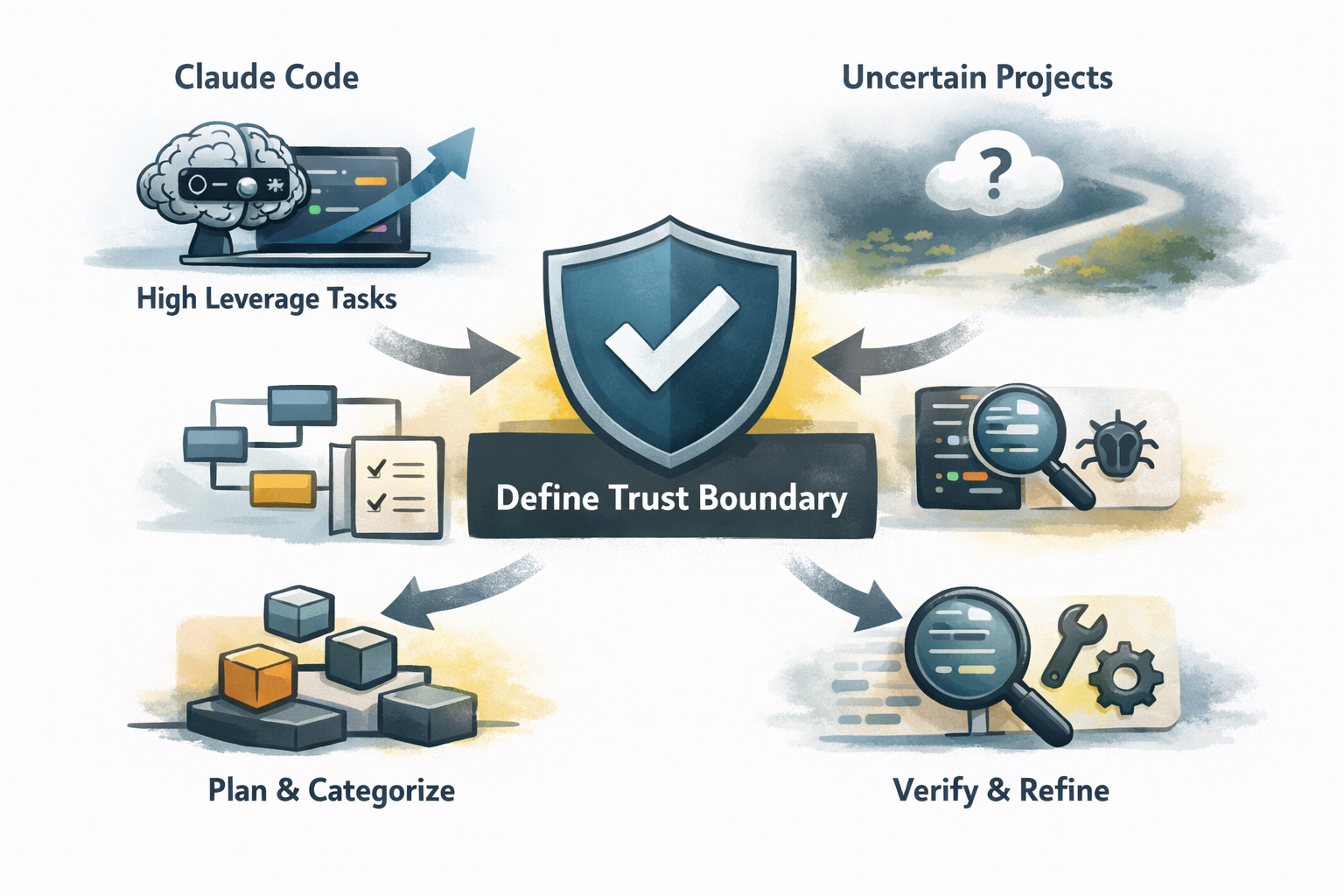
What is really noteworthy about this wave of Claude Code discussions is not that it is better at writing, but that the community has finally moved the issue from functional brilliance to the boundary of responsibility: which tasks can be reliably entrusted, and which decisions must still be borne by people. When the focus of discussion becomes trustability, AI coding truly enters the team management layer, not just the individual tool layer.
I want to make the conclusion clear first: what Claude Code really amplifies is the already existing domain judgment; it will not make up domain judgment for you out of thin air. The clearer the requirements and acceptance, the more it resembles a high-leverage execution layer; the more floating the requirements and the fuzzy boundaries, the easier it is to amplify uncertainty into review tax.
Let’s first see the first misunderstanding: treating generative as deliverable
When many teams introduce AI coding, the first thing they see is the output, and the last thing they get stuck is verification. The reason is not complicated: just because the model can be generated does not mean that the organization can absorb it. What's really worth noting is not the speed of generation, but whether the task is defined to be verifiable.
In familiar areas, Claude Code performs well, usually not because it suddenly understands the business better, but because the team already has high-quality context: data structure, error handling practices, acceptable trade-offs, and existing test boundaries. These are actually the judgment assets you have accumulated over the years, and tools just convert them faster. On the other hand, when the problem itself has not been clearly defined, the model can only fill in the gaps with seemingly reasonable methods, which is fast in the short term but biased in the long term.
The second reality: the main cost is verification, not generation
The question is not whether it can be done, but whether it can be done stably, observably, and maintainably. This sentence is almost the watershed between success and failure in the context of AI coding.
If the task has a clear test baseline, the review will be part of the engineering process; if the task boundaries are vague, the review will degenerate into a human audit with high cognitive load. You will see senior engineers' time being eaten up by diff and hypothesis checking, and the delivery is superficially faster, but in fact the rework is higher.
So when measuring effectiveness, don’t just look at how much more you write. At least simultaneously pursue:
review timerework ratiodefect escape rate
Without these three dimensions, any productivity report card is likely to be an illusion.
The third shift: The point of competition shifts from coding speed to judging the supply chain
When mainstream tools can accelerate implementation, the difference is no longer who publishes the first version first, but who first turns the judgment process into a replicable system. What will really be copied is usually not the most complete system, but the system that is easiest to understand and implement.
This means that the competitive point is shifting from individual prompting skills to the team's ability to judge supply chain design: Do you have task classification? Is there a trust contract? Is there a record of decision-making? Is there a standard inspection surface for AI-assisted PR? Without these mechanisms, AI will only amplify individual differences; with these mechanisms, AI will amplify tissue throughput.
Put it back at the delivery site, you will first encounter the second-order impact
After putting Claude Code into the daily process, the common second-order impacts are usually:
- Adoption cost up front: Spend time redoing task inventory and process layering first instead of buying more seats first.
- The pressure on operability increases: how to roll back a failure, who has the right to overwrite, and who is responsible for the results must be defined first.
- Observability requirements improve: you have to track down in which context slice the erroneous assumption was introduced.
- Cognitive load redistribution: The review burden may be concentrated on senior engineers, forming a new bottleneck.
- Ownership boundary is more sensitive: If the human-machine division of labor between PM, TL, and engineers is unclear, errors will be amplified by the system.
- Evaluation burden expansion: not only looking at whether the function is correct, but also looking at consistency, stability and maintainability.
Adoption suggestions: first narrow the success area, then expand the coverage
If you want to get speed bonus stably, I suggest using four steps:
- Prioritize task classification: Category A (high structure, high verifiability) is introduced first; Category B (partly uncertain) is co-edited by humans and machines; Category C (high uncertainty, strategic) maintains human dominance.
- Establish a trust contract: Each type of task clearly defines acceptable error types, must-run tests, and must-review diff areas.
- Start with the smallest available dashboard: chase
lead time,review time,rework ratio,defect escape rate. - Use monthly reviews to adjust boundaries: Precipitate successful models into checklists and example libraries so that new members can copy them.
At the same time, one thing not to do just yet is clear: Don’t pursue end-to-end automation in areas where demand has not yet converged. This usually only creates false progress and ends up repaying the debt all at once during the integration period.
Claude Code is not a product judgment substitute, but a quality judgment amplifier. First there is verifiable domain judgment, and speed is an asset; otherwise, speed is just a delivery liability that accumulates faster.
Sources and References
Continue with related articles and stay within the same technical thread.
The real work of AI-driven leadership: Not buying new tools, but resetting the work system
Korn Ferry mentioned that only 22% of organizations believe they are ready for job redesign. What this signal really points to is not the maturity of tools, but that management tasks have been rewritten: the next wave of competition is in role design, verification links and closed loops of responsibility.
When the HR Operator starts organizing AI, the organizational absorption phase has already begun
A recent AI reading list on LinkedIn led by talent and HR operators is translating technical signals into management language. This is not just a collection of information, but a clear sign that companies are beginning to use policies, processes, and responsibility frameworks to absorb AI.
The real signal from Dispatch: Agent control plane is moving from desktop to mobile workflow
Anthropic's Dispatch seems to be just another mobile phone portal, but what actually changes is the rhythm of agent use and the division of organizational responsibilities. When delegation becomes instant, governance gaps will be magnified in advance; teams must first make up for permissions, status visibility, and takeover mechanisms, rather than rushing to pursue higher automation coverage.